
Lay summary by Steaphan Connell, reviewed by Dr Ryan West and a Dementia Lay Panel
Background
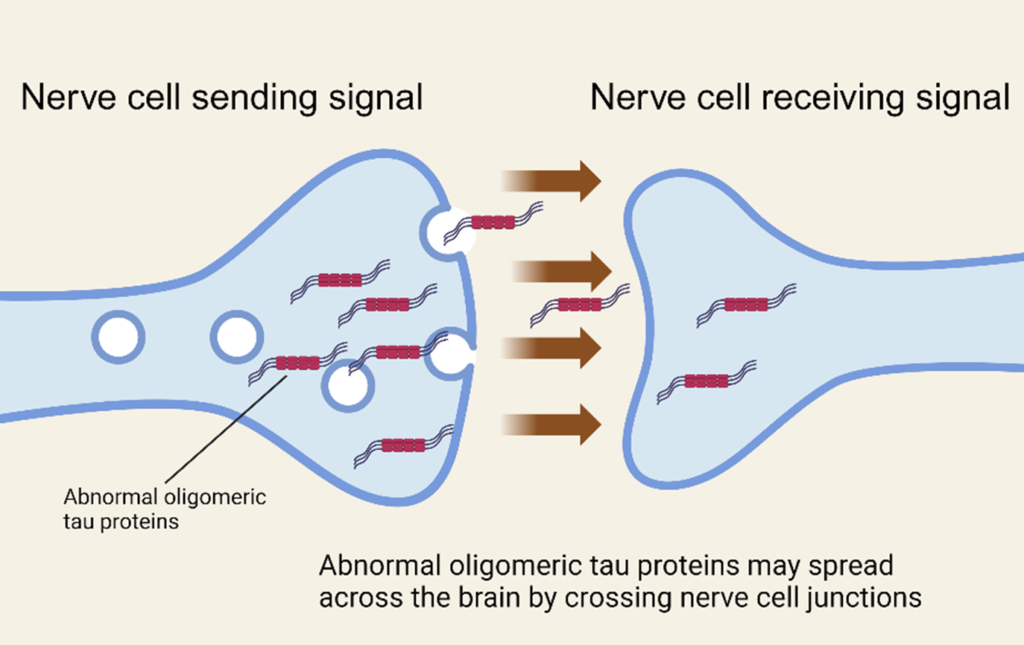
Alzheimer’s Disease symptoms are linked to the loss of nerve cell junctions in the brain. These are the point of contact and communication between two nerve cells. They are very important for memory, thinking and other brain functions as they allow different parts of the brain to communicate with each other, and can cause problems when lost. As well as the loss of these junctions, clumps of a protein called tau spread around the brain over the course of Alzheimer’s Disease. Tau has many roles in healthy brain function and usually helps with nerve cell signalling, but abnormal forms of this protein can cause problems. Clumps of abnormal tau protein known as ‘oligomeric tau’ are known to damage nerve cell junctions in mice brains.
From studying human brains at different stages of Alzheimer’s Disease, researchers can get a picture of what changes as the disease progresses. They noticed that abnormal tau seems to build up in areas that are connected to each other by nerve cell junctions. Abnormal tau can spread across these junctions in mouse brains, so researchers know that this possible, but haven’t yet seen it in human brains. In the current study, the researchers wanted to find out how abnormal tau spreads in human brains, and whether it happens at nerve cell junctions.
Why is the study important?
By understanding how abnormal tau proteins spread around the brain over the course of Alzheimer’s Disease, researchers can work on treatments which target the specific methods of spreading. It is also important to learn more about the role of tau protein in Alzheimer’s Disease in order to build up a full picture and help to understand how they work together with other proteins to cause symptoms.
What did the authors do and how did they do it?
The researchers used microscopes to look at sections of brain from people that lived with Alzheimer’s Disease that donated their brains to research after death. The high-powered microscopes allowed them to see tiny structures within the nerve cells and see where the junctions are. Substances were added to the brain sections which attach to different forms of tau protein. These were then marked with a certain colour. Looking down the microscope, researchers could then see where the different forms of tau clumped together within the nerve cells in the brain. In this study, they wanted to see if abnormal tau specifically clumped together at the nerve cell junctions.
What are the results?
The key finding from this study was that abnormal forms of tau are seen at the ends of nerve cells, just before and after nerve cell junctions. This suggests that the tau travelled across the junctions between the nerve cells. Out of all the different forms of tau, oligomeric tau was seen most often.
What do the findings mean going forward for people with the disease?
Oligomeric tau may be useful as a new target for Alzheimer’s Disease treatments, which would aim to reduce the oligomeric tau at nerve cell junctions or prevent it from spreading across. It is important to note that abnormal tau is not the only protein associated with Alzheimer’s Disease symptoms, but by understanding different aspects of the disease, we can build a better overall picture of how it works.
This study can be found at
https://doi.org/10.1016/j.neuron.2023.04.020
Paper title
Synaptic oligomeric tau in Alzheimer’s disease — A potential culprit in the spread of tau pathology through the brain
Lead Authors
Colom-Cadena, M., and. Spires-Jones, T. L.
Publication details including date of publication
Neuron 111(14), 2170-2183 (2023).