
Lay summary by Rachel Hughes, reviewed by Dr Scott Allen & a Parkinson’s disease lay panel
Background
Parkinson’s is a disorder resulting in a reduction of dopamine in the brain, causing a person to experience tremors, slowed movement and rigidity. People with Parkinson’s can also experience a multitude of other symptoms, both motor and non-motor. Motor symptoms may include dystonia (repetitive muscle cramping), freezing (stuck in one place) and a walk that resembles a shuffle, using small steps. Non-motor symptoms, which often affect quality of life more than motor symptoms, include, but are not limited to, pain, fatigue and depression. Every person with Parkinson’s will experience different symptoms, this means it is more likely that people will react differently to the medications used to treat Parkinson’s.
Parkinson’s can be influenced by a few different factors. In the brains of all people there is a protein called alpha synuclein. The role of alpha synuclein isn’t fully understood yet but in people with Parkinson’s, alpha synuclein builds up and clumps, eventually forming Lewy bodies. Another factor that can influence Parkinson’s are the mitochondria, which can be thought of as the batteries of cells. It is the job of the mitochondria to produce the energy that a cell needs to survive. In a person without Parkinson’s, damaged mitochondria can be removed from a cell by a process called mitophagy. This maintains a healthy pool of mitochondria meaning that the cell can function effectively.
There are several different mitophagy pathways, involving different proteins, however the most studied pathway involves two proteins called PINK1 and Parkin. When the mitochondria are healthy, PINK1 gets broken down and prevents Parkin from being attracted to the mitochondria. However, when the mitochondria become damaged, another protein called BNIP3 stops PINK1 from being broken down, causing it to accumulate on the mitochondria. This then attracts Parkin to the mitochondria and tells the cell that it needs recycling. This is shown in the diagram below. In people with Parkinson’s, this removal pathway can be faulty, leading to an accumulation of damaged mitochondria in the cell, eventually leading to cell death.
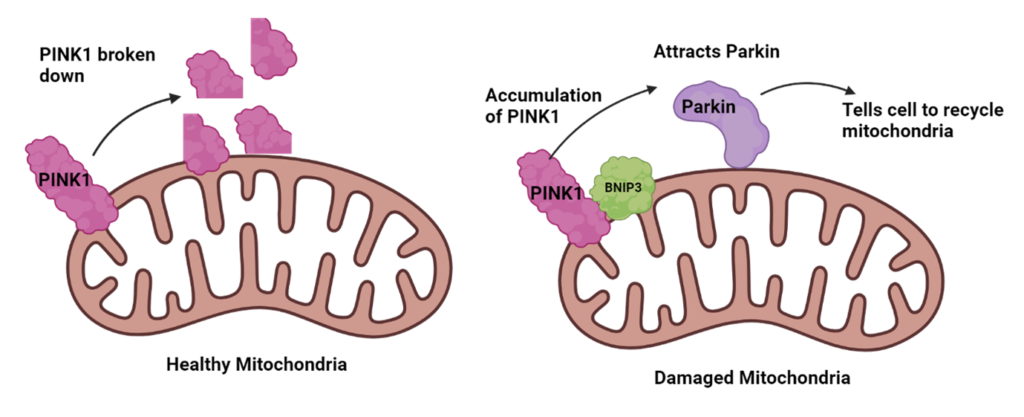
Why is the study important?
The current medications available to treat Parkinson’s are not disease modifying, meaning that they only treat the symptoms without altering how the disease progresses. Therefore, it is important to conduct studies to identify new or repurposed drug compounds that could potentially modify the disease. Repurposed drugs are those that are already approved and available for use to treat other conditions. These are then screened to investigate whether they would be of benefit in a different condition.
What did the authors do and how did they do it?
In this study, the authors used a drug, fingolimod, which is currently approved for the treatment of multiple sclerosis (MS). The authors used fingolimod in a mouse model of Parkinson’s caused by a known toxin. Mice don’t naturally develop Parkinson’s, therefore to study Parkinson’s in mice, it is common practice to treat them with toxins that we know cause the condition. Fingolimod works by interacting with a protein called sphingosine-1 phosphate receptor 1 (S1PR1). S1PR1 is thought to be involved with PINK1/Parkin mitophagy and has been shown to be reduced in people with Parkinson’s. Therefore, the authors wanted to study whether fingolimod could have positive effects in Parkinson’s and whether these effects were through S1PR1 which can then affect PINK1-Parkin-BNIP3 mitophagy.
Mice were split into 5 groups, as shown in the table below.
| Group Name | Toxin given? | Drug given? |
| Healthy | No | No |
| Disease control | Yes | No |
| High dose | Yes | Yes, high dose |
| Low dose | Yes | Yes, low dose |
| Drug control | No | No |
Although those in the drug control group were not given toxin or drug, to ensure any compound effects were real, they were treated only with the substance in which the drug was dissolved in. Any mice receiving the drug were given fingolimod 1 hour before the toxin.
Mice were assessed for their behaviour on a rotarod test (a rotating rod to assess coordination), as well as natural behaviours such as total distance travelled and the number of times they stood on their back legs (rearing). Rearing is a normal behaviour for mice as they explore their environment, therefore less rearing is an indication that something is wrong. These tests provide important information that can be linked to humans as they assess motor coordination and balance. Tests were carried out before any treatments and then following 21 days of toxin/drug treatments.
Brain tissue samples from the mice were also used for biochemical investigations.
What are the results?
When assessing measures of behaviour, the disease control mice (toxin, no drug) were slower, didn’t travel as far and didn’t rear on their hind legs as frequently as the healthy mice. However, when treated with both low- and high- dose fingolimod, these behaviours were less evident, meaning that the mice remained healthier.
As mentioned, people with Parkinson’s have a reduction of dopamine in the brain. Therefore, in this study the authors were interested in expression of tyrosine hydroxylase (TH), a protein involved in the generation of dopamine. The authors found that the disease control group had less TH compared to the healthy mice, but after fingolimod treatment, an increase in TH was seen suggesting that an increase in dopamine production could be happening. This would be of benefit to people with Parkinson’s as increasing or restoring dopamine would aid in relief of symptoms.
The authors were also interested in levels of alpha synuclein, the protein that clumps in the brains of those with Parkinson’s. As expected, the disease control group had more alpha synuclein than the healthy group. When treated with fingolimod, there was less alpha synuclein present than in the disease control group. This occurred in a dose-dependent way, meaning the higher the dose of fingolimod, the lower the levels of alpha synuclein.
Finally, to assess whether fingolimod was affecting PINK1, Parkin or BNIP3, they looked at the levels of these proteins in the brain. In each case they found that the drug control group had lower levels and that treatment with fingolimod resulted in an increase. This means that when fingolimod is given, mitophagy is increased and the damaged mitochondria are being more efficiently removed from the cell, indicating that the cells are healthier. Although this wouldn’t replace the cells already lost in Parkinson’s, it could stop more cells from being lost.
What do the findings mean going forward for people with the disease?
This study has identified fingolimod as a potential new treatment for Parkinson’s, however more work is needed to confirm its ability to improve Parkinsonian features, especially in humans. This was a small study (12 mice per group) that used a toxin to cause Parkinson’s in mice. Most human Parkinson’s cases are sporadic, meaning we don’t know the cause of the disease. Therefore, it would be beneficial to test this drug in a different model, ideally in cells that have been donated by people with Parkinson’s. Furthermore, the researchers treated the mice with fingolimod before the toxin was given, which is not representative of human Parkinson’s, where symptoms would occur before treatment. Following more comprehensive testing, clinical trials would need to be undertaken to investigate the effectiveness of fingolimod in people with Parkinson’s before it is brought to market.
This study can be found at
https://www.sciencedirect.com/science/article/pii/S0304394023005554
Paper title
Fingolimod exerts neuroprotection by regulating S1PR1 mediated BNIP3-PINK1-Parkin dependent mitophagy in rotenone induced mouse model of Parkinson’s disease
Lead Authors
Shruti Rajan and Dharmendra Kumar Khatri
Publication details including date of publication
Neuroscience Letters, Published online December 2023