
Lay summary by Madeline McGinnis, reviewed by Dr Liam Knox.
Background
Stroke is one of the leading causes of death globally, and roughly 80% of people with stroke have an ischaemic stroke. One of the worst types of ischaemic stroke is caused by the blockage of a major blood vessel in the brain, called large vessel occlusion. Cells in the brain rely heavily on the oxygen and nutrients supplied by the blood, so when blood flow is restricted (“ischaemia”), these cells begin to die, leading to stroke. To prevent further damage and allow the brain to recover, it is important to restore blood flow by removing the blockage.
There are two main treatments to remove this blockage. Firstly, within hours of onset (and if deemed safe for the patient), a clot-dissolving agent is injected, which travels through the blood to start breaking down the blockage. This process is called thrombolysis. The patient can then undergo thrombectomy, where a wire is inserted into an accessible blood vessel and navigated to the blockage to either remove it by suction or by pulling it out with a wire mesh.
If the procedure goes well, there is “successful reperfusion” of the impacted area—i.e., blood flow is restored to the brain. In the long-term, another marker of success is how quickly the stroke patient can achieve “functional independence”, such as moving, bathing and eating without help.
Why is the study important?
One of the biggest factors when treating acute (within the first few hours of symptom onset) ischaemic stroke is time: the longer the affected area of the brain goes without blood and oxygen, the more likely further damage and cell death will occur. As such, it is vital that the treatment itself is both effective at limiting the damage as well as time-efficient. Constant improvement of the current stroke treatments are therefore crucial, which is why studies such as this one are so important. This study asks: do we need to do both thrombolysis and thrombectomy, or is thrombectomy alone better and safer?
What did the authors do and how did they do it?
The authors recruited 550 total patients across 39 different hospitals in China. These patients had acute ischaemic stroke—caused by large vessel occlusion—within 4.5 hours of symptom onset, and were eligible for thrombolysis. Those at high risk of bleeding or on blood thinners were excluded.
Patients were randomly assigned to one of two groups. The first group received the thrombolysis treatment—an injection of the thrombolytic agent tenecteplase—to initiate breakdown of the clot, and also received the thrombectomy. The second group of patients received the thrombectomy alone.
The main measure was how many patients were functionally independent 90 days post-stroke. Functional independence was defined as scoring 0 to 2 on the modified Rankin scale; a 7-point scale with higher scores indicating severe disability of the patient. The study also investigated the percentage of patients with successful reperfusion before and after thrombectomy in both groups, as well as comparing how many patients presented with haemorrhage (brain-bleed) symptoms within 48 hours of the treatment, and how many passed away within 90 days.
What are the results?
The main findings of the study are summarised here:
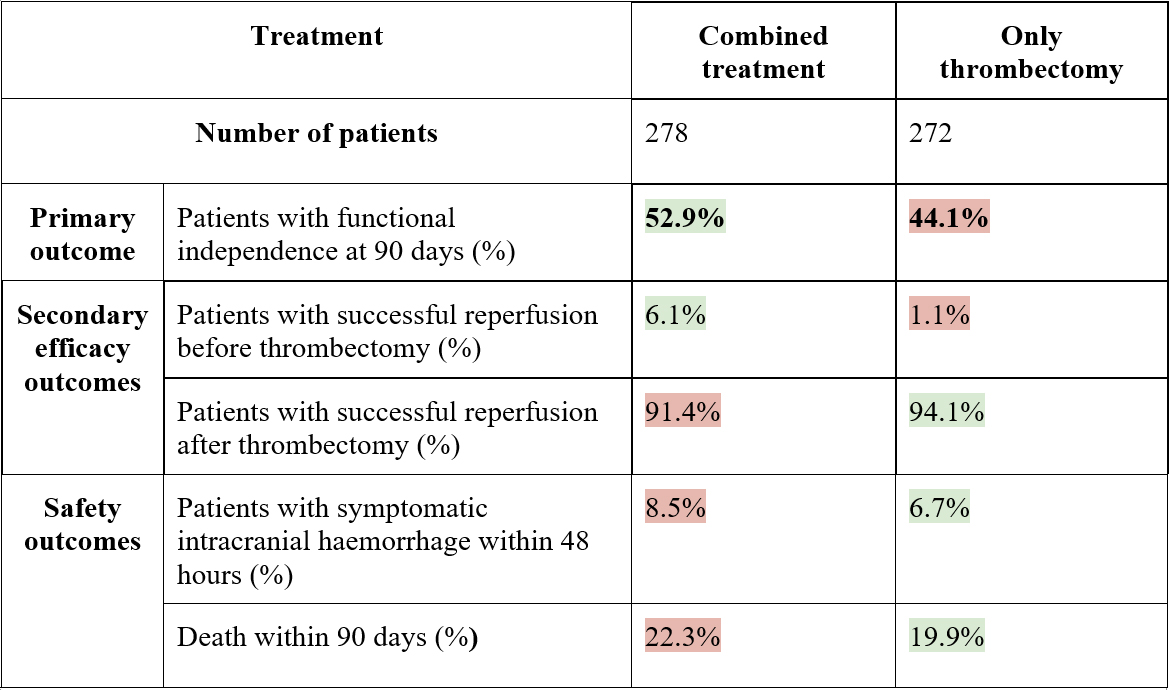
The primary outcome showed that a significantly higher proportion of patients in the combined treatment group (both thrombolysis and thrombectomy) had functional independence after 90 days, in comparison to the thrombectomy-only group. There were no statistically significant differences in the other outcomes. Comparatively positive outcomes are highlighted in green, and negative in red.
What do the findings mean going forward for people with the disease?
These findings suggest that, for patients eligible for thrombolysis, combining it with thrombectomy leads to better recovery 90 days after the stroke, with no significant increase in the likelihood of bleeding or death.
The study used tenecteplase which—though becoming more common—is still less widely used than the standard thrombolytic agent, alteplase. However, tenecteplase has some potential advantages: it remains in the body longer, may carry a lower risk of brain bleeding, and can be administered faster. In this study, it led to a shorter time between thrombolysis and thrombectomy compared to alteplase use in other trials—a factor associated with better functional outcomes.
While the primary outcome supported using the combined treatment, the secondary and safety outcomes showed no significant benefit. This ultimately suggests that further research is needed, and a direct comparison of tenecteplase and alteplase could be a promising place to start.
This study can be found at
https://www.nejm.org/doi/10.1056/NEJMoa2503867
Paper title
Intravenous Tenecteplase before Thrombectomy in Stroke
Lead authors
Z. Qiu & Q. Yang
Publication details including date of publication
This paper was published in the New England Journal of Medicine on the 25th May, 2025
Citations
Qiu, Z., Li, F., Sang, H., Yuan, G., Xie, D., Zhou, K., Li, M., Meng, Z., Kong, Z., Ruan, Z., Li, C., Yang, G., Wu, J., Long, C., Yang, B., Hu, H., Li, Y., Luo, J., Shi, Z., … Yang, Q. (2025). Intravenous tenecteplase before thrombectomy in stroke. New England Journal of Medicine, 390(23), 2127–2137.