
Lay summary by Rithika Bose and reviewed by Dr Raquel Martins
Background
Multiple sclerosis (MS) is a disease where the immune system mistakenly attacks the brain and spinal cord. This causes inflammation (the brain’s immune response to harmful substances), a toxic process that leads to damage and death of nerve cells. Ultimately, inflammation in specific regions leads to problems with movement, vision, and coordination. In this study, researchers looked at changes in the DNA of neurons (nerve cells) from people with MS. These DNA changes, called mutations, are not inherited or passed on. Instead, they occur randomly due to environmental factors or errors when cells divide. The researchers found a specific type of mutation called a somatic single-nucleotide variant (sSNVs), which means a single “letter” in the DNA sequence was changed in some nerve cells. This was only found in damaged brain areas in MS patients.
Why is the study important?
Patients with MS typically present lesions (areas of tissue damage) in the brain and this corresponds to different levels of inflammation. The lesions appear as ‘spots’ on brain scans (MRIs) and reflect the areas in the brain where there is past or ongoing inflammation. It is still not fully understood how inflammation triggers DNA mutations and causes damage to brain cells. Better understanding of these processes is crucial to develop protective or repairing therapies, with the potential of preventing and/or slowing the progression of different forms of MS.
What did the authors do and how did they do it?
The researchers examined brain tissue from 10 MS patients and 5 healthy individuals. For MS patients, tissue samples were collected from areas of the brain with and without lesions. The same areas of the brain were collected from healthy individuals for comparison. DNA samples from MS patients were also taken for whole-genome sequencing (the process of looking at a person’s DNA all at once to identify changes or mutations). To identify neurons, all nerve cells in the brain tissue were stained with a dye to locate the nucleus of the neurons. The nucleus is the control centre of the cell which holds the DNA. A solution was used to break open the nucleus and extract the DNA. Then, a test called a PCR, which makes more copies of multiple DNA regions, was used for whole genome sequencing.
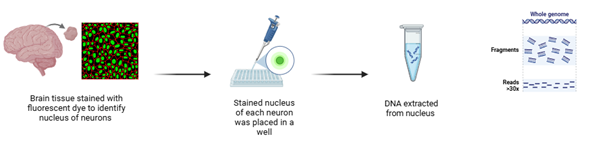
The researchers first stained brain tissue from MS patients and healthy individuals with a fluorescent dye. This dye helped them see and identify the nuclei (centres) of nerve cells under a microscope. Each stained nucleus was placed into separate wells (tiny containers). DNA was extracted from each nucleus and prepared for a method called whole-genome sequencing, where each piece of DNA is read over 30 times to ensure high accuracy. This allowed scientists to examine the entire DNA sequence of each neuron and detect small changes called mutations.
What are the results?
Damaged Areas have More Mutations
The researchers found that neurons located at MS lesions have over twice as many DNA mutations compared to healthy brains and normal appearing MS tissue (without lesions). This suggests that inflammation over time may speed up the damage to neurons. They also found that the number of mutations seen in MS patients was more closely linked to a person’s age than by how long they had the disease. In addition, mutations build up quicker with age in the long-lasting areas of damage in the brain. This means that certain brain areas become more vulnerable with age and are therefore more prone to damage.
Damage Patterns seen in MS neurons
Another interesting finding was that when mutations occur, specific patterns in the DNA are left behind. These patterns are called mutational signatures and a variety of mutational signatures cause damage to MS neurons. The researchers found five signatures which were more commonly found in neurons from MS lesions compared to nearby normal appearing tissue. Each signature represented a different type of damage occurring in neurons including: the aging process, inflammation and toxic cell stress.
This suggests that certain processes capable of causing mutations are more active in the damaged areas of MS brains. Similar patterns were seen between male and female; however, the study did not have enough data on whether sex plays a role in the mutation patterns seen.
What do the findings mean going forward for people with the disease?
The findings from this study provide several important conclusions. The identification of mutations caused by inflammation shows a potential for developing targeted approaches that could stop or reduce the lesions in the brain. Drugs that protect or restore the neurons could be used to work alongside existing drugs for MS. The study also highlights that age is a better predictor of damaging DNA change than the amount of time someone has had the disease. As patients age, they may build up more mutations which could correlate with disease progression. Understanding this may help tailor treatments based on age and mutation burden. It is important to find ways of targeting brain inflammation before damage occurs. This would help slowing down the progression of the disease and could improve long-term outcomes for patients.
This study can be found at
www.nature.com/articles/s41593-025-01895-5
Paper title
Neuronal somatic mutations are increased in multiple sclerosis lesions
Lead Authors
Allan Motyer and Justin P. Rubio
Publication details including date of publication
Motyer, A., Jackson, S., Yang, B. et al. Neuronal somatic mutations are increased in multiple sclerosis lesions. Nat Neurosci (2025). https://doi.org/10.1038/s41593-025-01895-5