
A lay summary written by Alannah J. Mole, PhD.
Background
Microbes, including bacteria, are small organisms that exist in the environment. Microbes are a normal part of gut health, however, when their balance is disrupted, this can weaken the lining of the gut and allow more microbes to leak into the bloodstream. In response to this, the body may attempt to counteract this in ways which can contribute towards disease. Disruption to the microbial balance of the gut is becoming increasingly recognised as an important factor in many diseases, including motor neuron diseases like Amyotrophic Lateral Sclerosis (ALS).
In mouse models of ALS, it has been shown that disruption to the balance of gut microbes occurs prior to symptom onset and, in animals, correction of imbalances can slow disease progression, whilst increased disruption can accelerate disease progression. In patients, however, there are conflicting reports: some studies suggest that there is a relationship between the microbial balance and ALS susceptibility and severity, whilst others fail to make this connection. The reason for such discrepancies may be due to a lack of appreciation for the importance of distinguishing between different categories of ALS, which could prevent us from identifying links between bacterial imbalance and ALS in humans. This current study categorises ALS patients based on the location of their disease onset (spinal or bulbar) and considers them as separate populations. Spinal-onset ALS is characterised by weakness and wasting of muscles in the limbs and trunk, whereas bulbar-onset is characterised by weakness in muscles involved with speech and swallowing. In this work, bacterial profiles in the mouth and the gut in spinal- versus bulbar-onset patients is analysed, to try and identify differences and consider how these differences might be useful in, firstly, predicting disease, and secondly, predicting the severity of disease.
Why is the study important?
Spinal-onset ALS and bulbar-onset ALS are often grouped as a single disease, however this work suggests that there could be important and onset-specific differences in the microbial composition of the mouth and gut that could act as drivers of disease. This study highlights not only the importance of better categorising ALS types, but also how bacterial balance disruption could represent an important therapeutic target for people with ALS. This is particularly important as it indicates that different drugs could be more effective in different scenarios.
What did the authors do and how did they do it?
Faecal and saliva samples were collected from patients within 12 months of disease onset and split into either spinal-onset ALS (24 patients) or bulbar-onset ALS (12 patients). Samples were also collected from the patient spouse or partner, to act as a normal, comparative sample for each patient to account for environmental differences (e.g. differences in diet). ALS severity was assessed by the ALSFRS-R scoring system, which is a 12-item assessment that assesses different aspects of motor control: bulbar (including speech, salivation and swallowing); fine motor (including handwriting, use of utensils, dressing and hygiene); gross motor (including turning in bed and adjusting bed clothes, walking and climbing stairs); and respiratory (including general shortness of breath, shortness of breath when lying down, and breathing efficiency). DNA was extracted from either saliva (collected by spitting into a tube), stool (collected at home after fasting overnight), and subjected to next generation sequencing to look at and compare the different types of microbes that are present between different patient groups. ‘Next generation sequencing’ is a new type of DNA sequencing technology, which allows us to look much more closely and quickly at several portions of an individual’s genetic makeup than ever before. Blood analyses were conducted to assess the extent to which microbes in the gut had moved into the bloodstream through the gut lining.
What are the results?
The first major outcome of this work is the finding that spinal-onset ALS patients primarily have bacterial disruption in the gut, whereas in bulbar-onset ALS patients have bacterial disruption in the mouth. Spinal-onset ALS patients had a greater number of different types of bacteria in the gut than in bulbar-onset patients, whereas bulbar-onset patients had a greater number of different types in the mouth.
To expand on what sort of disruption in bacteria is present in different cases, the ratios of more specific, different bacterial species were compared between groups. It was found that there were shifts in the ratio of the specific species: Firmicutes and Bacteroidetes (referred to as the F/B ratio). The results of this study suggest that a shift in faecal ratio is the source of imbalance in spinal-onset ALS, whereas a shift in the oral ratio is responsible for the imbalance in bulbar-onset ALS.
An even deeper analysis of the bacterial species responsible for causing changes to the bacterial ratios indicated that the main driver in spinal-onset ALS was specifically an enrichment of the Ruminococcaceae family and depletion of the Bacteroidaceae family. Similar changes to these specific families have been reported in Parkinson’s disease and Alzheimer’s disease in both animal models and patients. In bulbar-onset ALS, ratio changes were mainly driven by enrichment of Prevotellaceae family, and decrease in Veillonellaceae family. Interestingly, Parkinson’s disease patients have also been shown to have an enrichment of Prevotellaceae in the mouth.
Finally, a specific bacteria (Fusobacteria) was found to be enriched in both spinal and bulbar-onset ALS patients in either faeces or saliva, respectively. This type of bacteria has been previously associated with weakening the lining of the gut, which allows bacteria to more easily leak into the bloodstream which could cause disease. This work concludes that faecal or oral enrichment of this bacteria may therefore be a driver of disease.
Overall, in both spinal and bulbar-onset ALS cases, greater bacterial imbalance was shown to line up with greater leakage into the bloodstream from the gut, and greater disease severity.
The following diagram (labelled Fig.1) helps to summarise these results and highlights an exciting concept moving forward.
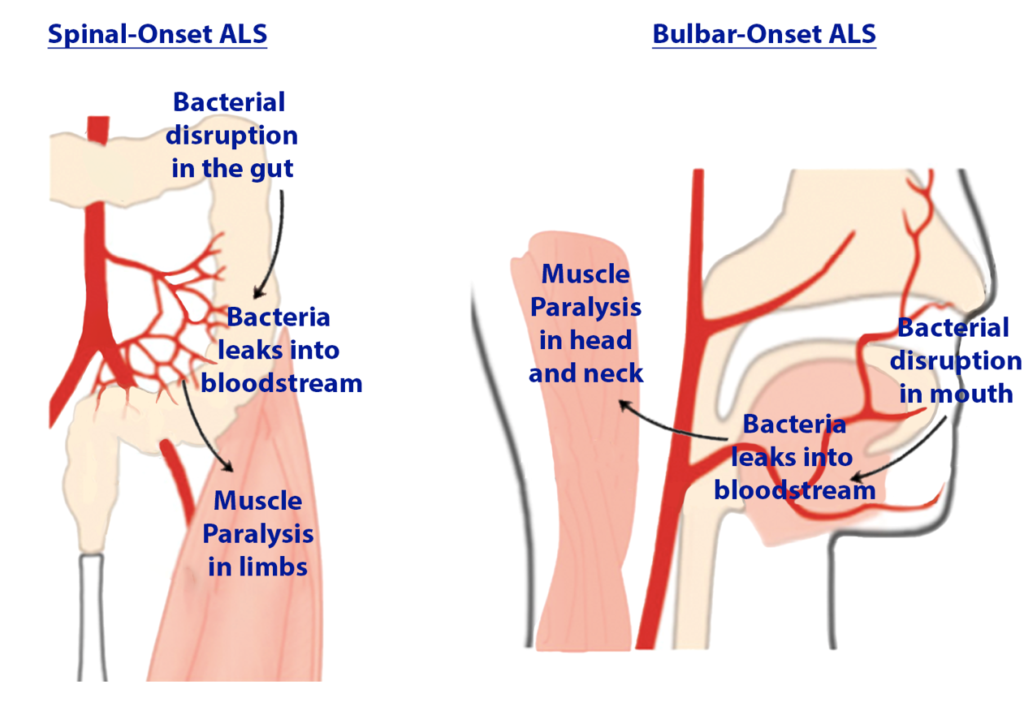
Fig. 1: Diagram summarising how bacterial disruption may drive disease in ALS. Overall, bacterial leakage into the bloodstream is proposed to trigger disease in muscles that lie closest to the origin of the imbalance. This figure is adapted from Fig.8 of the original scientific manuscript by Kim et al., 2022, whereby original text has been removed and simplified using Adobe Photoshop; this adaptation is undertaken in line with Creative Commons Attribution 4.0 International License, which can be viewed here: https://creativecommons.org/licenses/by/4.0/.
Spinal-Onset ALS: Normally, the gut lining acts as a barrier to prevent unwanted microbes from the environment entering the blood. Disruption to bacteria in the gut, however, results in swelling and a weakening of this lining, which allows microbes to enter the bloodstream and disrupt the blood vessels and nerves that normally supply muscles nearby in the limbs, which can trigger paralysis. As failure of the gut barrier continues, higher and higher levels of microbes enter the blood, and can worsen symptoms.
Bulbar-onset ALS: Normally, mucous linings in the mouth act as a barrier to prevent unwanted microbes from the environment entering the blood. Disruption to the bacteria in the mouth results in swelling and a weakening of these linings, which allows microbes to enter the bloodstream and disrupt the blood and nerves that supply muscles nearby in the head and neck, which can trigger paralysis. As the lining in the mouth continues to leak, higher and higher levels of microbes enter the blood, and can worsen symptoms.
What do the finding mean going forward for people with the disease?
Changes to the microbial composition in the mouth (bulbar-onset ALS) or gut (spinal-onset ALS) ultimately results in weakening of the linings of the gut. In the case of bulbar-onset ALS, where bacteria is disrupted in the mouth, then this could permit tissues that underlie this becoming compromised, and explain why onset in these cases is predominantly in the head and neck. In the case of spinal-onset ALS, this imbalance is in the gut, and this may explain why onset predominantly occurs in limb muscles. The main caveat of this work is the relatively small sample size, however rigorous exclusion criteria and the use of spousal controls to control for environmental effects does help towards mitigating this. There is also extensive analyses performed to attempt to identify and account for other confounding factors including differences in oral health, and differences due to age/body type and disease duration, however even after corrections are applied to the data to account for these differences, the conclusions of the work remain the same, thereby providing further confidence in the results. Overall, this work has particular importance, as not only does it indicate that spinal-onset and bulbar-onset ALS should be treated as separate diseases, but also that manipulating the bacterial populations of the mouth and gut represents an intriguing and exciting therapeutic target in ALS approach. This study suggests correcting gut-dysbiosis as a therapeutic strategy for spinal-onset ALS patients and correcting oral- dysbiosis as a therapeutic strategy for bulbar-onset ALS patients.