
Lay summary by Philippa Pease, reviewed by Dr Raquel Martins and a Dementia lay panel.
Background
Alzheimer’s disease (AD) is a progressive condition where brain cells (neurones) gradually die, leading to memory loss and difficulties with thinking, reasoning, and everyday activities. Two abnormal proteins, known as amyloid beta and tau, build-up in the brains of people with Alzheimer’s disease. These proteins form clumps that disrupt communication between brain cells at the synapses (the points where brain cells send messages to each other). The breakdown of communication between neurones at synapses is thought to happen early in the progression of Alzheimer’s disease, causing neuroneal death and driving the development of memory problems.
Recently, scientists have become especially interested in a group of proteins called neuronal pentraxins (NPTX). These proteins help maintain healthy communication between brain cells. One of these proteins, NPTX2, is often found at lower levels in people with Alzheimer’s disease, particularly in the fluid surrounding the brain and spinal cord (known as cerebrospinal fluid, or CSF). Lower NPTX2 levels are linked to memory problems and the shrinkage of the hippocampus, a region of the brain that is essential for learning and memory.
NPTX2 may also help protect the brain by keeping immune cells in balance. When NPTX2 levels drop, the brain’s immune cells, called microglia and astrocytes, can become overactive. This can lead to harmful inflammation and contribute to the build-up of tau protein, causing further damage to neurones and synapses. However, it is still not fully understood how changes in NPTX2 trigger these harmful processes. This study therefore aimed to identify the sequence of events that occur when NPTX2 levels change and understand how this may contribute to memory loss in Alzheimer’s disease.
Why is the study important?
Damage at synapses (therefore affecting the ability for neurones to communicate) happens long before the first symptoms of Alzheimer’s disease appear. By studying NPTX2, researchers hope to learn more about the early processes that lead to neuronal damage and memory loss. This knowledge could improve early detection of Alzheimer’s disease as well as point to new treatment strategies that slow disease progression. This is very important given the limited treatments currently available.
What did the authors do and how did they do it?
The researchers analysed data from 263 individuals taking part in the Alzheimer’s Disease Neuroimaging Initiative (ADNI), a long-term study tracking changes to the brain and individuals’ cognitive ability over time. These participants were selected since they had detailed clinical information that was already accessible, including results from memory and thinking tests and samples from their CSF. The researchers used these CSF samples to specifically measure levels of NPTX proteins, tau protein, amyloid-beta, and two immune-related proteins called sTREM2 and GFAP (which are produced by microglia and astrocytes, respectively, when they become reactive).
Researchers then compared these protein levels across people with normal cognition, mild cognitive impairment, or Alzheimer’s dementia. They also used advanced statistical models and brain imaging techniques to compare the level of atrophy (brain tissue loss) between groups and explore whether inflammation might explain the link between low NPTX2 levels in people with Alzheimer’s disease and loss of memory, via increased tau production.
What are the results?
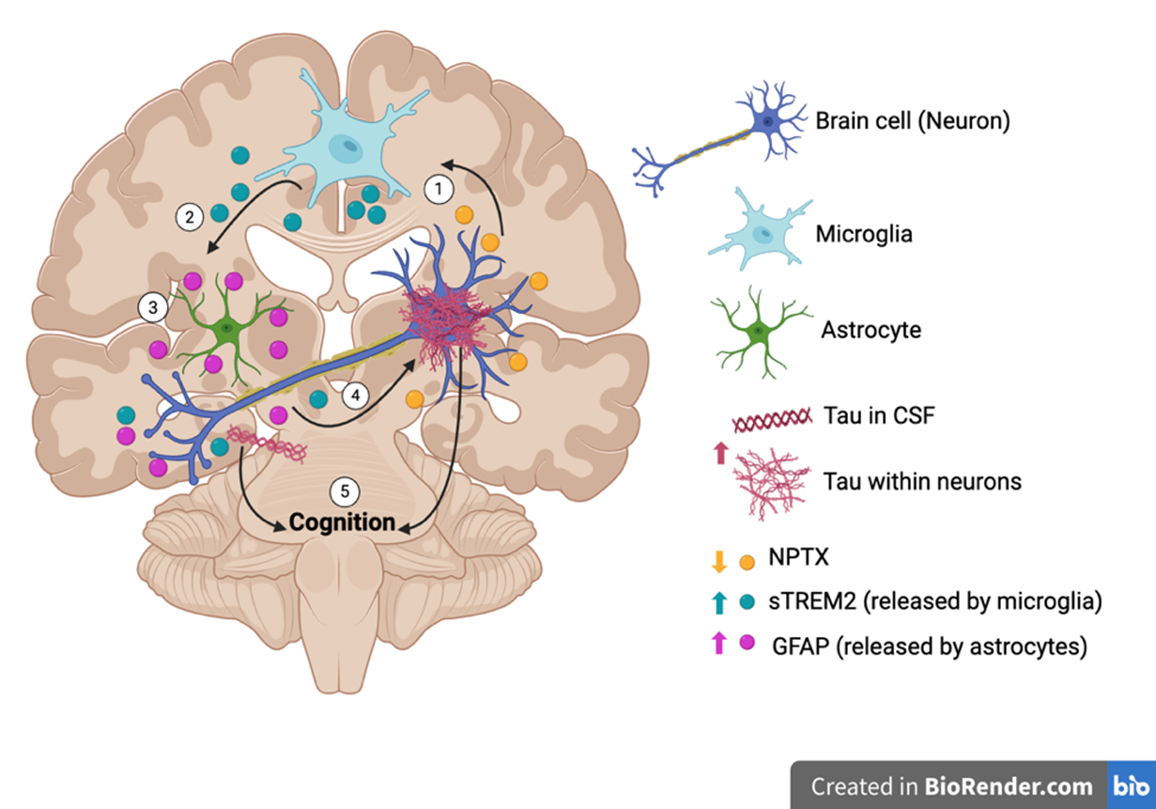
Across the group, researchers interestingly found that participants with higher levels of tau and clear signs of neuronal death, also showed higher NPTX protein levels. While this might seem unexpected, it likely reflects a temporary compensatory response: as tau begins to build-up and put stress on neurones, the brain may try to release more NPTX proteins to maintain communication between cells. But as Alzheimer’s disease progresses, NPTX levels eventually fall. At this point, they can no longer protect synapses, contributing to worsening memory problems. In the patients with clear memory and thinking difficulties, NPTX levels were no longer sufficient to prevent cognitive decline.
The study also showed that the link between low levels of NPTX proteins, tau build-up, and subsequent memory loss is partly explained by increased activity of the brain’s immune cells. Individuals with higher levels of sTREM2 and GFAP in their CSF (produced when microglia and astrocytes become reactive) were more likely to show this connection (see Figure 1). Importantly, this relationship did not depend on amyloid-beta levels, suggesting that NPTX proteins are more closely linked to tau-related brain damage than to amyloid-beta build-up.
What do the findings mean going forward for people with the disease?
Understanding how changes in NPTX levels, particularly NPTX2, activate microglia and astrocytes and contribute to tau build-up, can help explain why communication between brain cells breaks down and leads to memory loss in Alzheimer’s disease. By uncovering this chain of events, researchers can better understand the early mechanisms that drive the disease. This is crucial for developing new treatments which could be aimed at keeping NPTX2 levels stable and preventing harmful immune overactivity. In summary, monitoring and targeting NPTX2 could offer a new way to protect the connections between brain cells, slow cognitive decline and ultimately improve the quality of life for people living with Alzheimer’s disease.
This study can be found at
https://doi.org/10.1186/s12974-025-03545-w
Paper title
Cerebrospinal fluid neuroneal pentraxin levels are associated with tau pathology via microglia–astrocyte signalling in Alzheimer’s disease
Lead author
Z. Zhang & W. Zou
Publication details including date of publication
Springer Nature Journal of Neuroinflammation, Volume 22, Article 221. Published 2nd October 2025