
A lay summary written by Natalie Pyre and reviewed by Dr Scott Allen and a Dementia lay panel.
Background
Autophagy (Auto – self, Phagy -eating) is the cells way of breaking down and recycling its damaged parts and material to keep the cell healthy. In Alzheimer’s disease (AD), the nerve cells (neurones) have problems in this autophagy process, but how this may cause the disease is not yet understood.
Microglia are the support cells of the brain, they keep it clean and healthy, to allow the neurones to do their job properly. To do this, the microglia use autophagy to break down toxic protein clumps, some of which if left uncleared, promote AD development.
Why is the study important?
Researchers have found that in mice with AD-like disease, some microglia protect the neurones against these toxic protein clumps, whilst others do not. By understanding why only some microglia are protective, we can try find therapies to promote the helpful microglia or prevent the unhelpful ones, to try and stop the development of AD.
What did the authors do and how did they do it?
To test if the level of autophagy in microglia affects whether it is protective or not, the researchers used mice which have toxic clumps of the protein amyloid-beta, which are found in the brains of humans with AD. The microglia are taken from the mice and grown in a dish, then they can measure the level of autophagy in the microglia by looking at the levels of proteins made in the autophagy process.
What are the results?
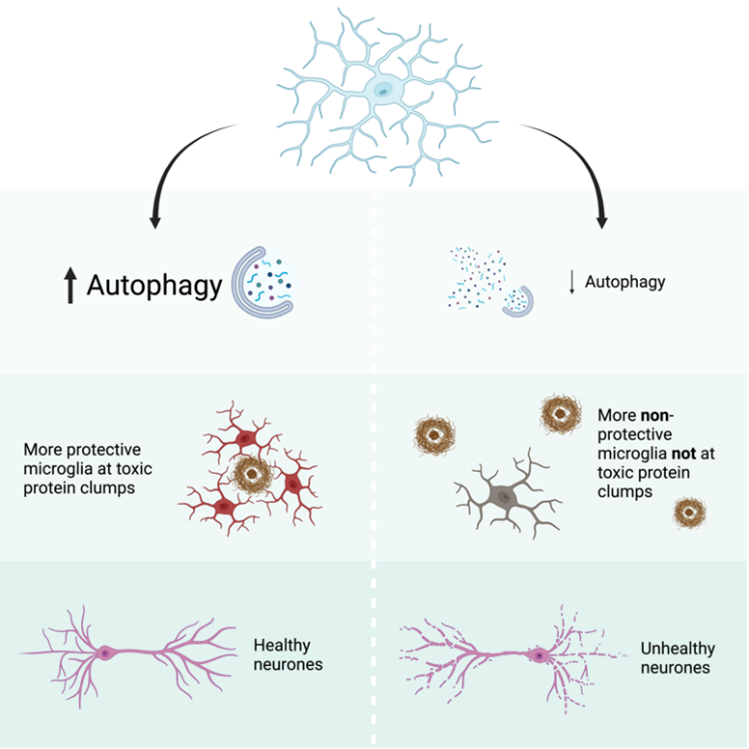
The researchers found that autophagy is activated in the protective microglia surrounding the toxic amyloid-beta clumps in the AD-like mice. By preventing autophagy, less protective microglia surrounded the toxic clumps, suggesting that loss of autophagy causes less toxic amyloid-beta clump clearance and more damage to neurones.
Additionally, loss of autophagy promoted the amount of non-protective microglia. Treatment that removed the autophagy-deficient non-protective microglia improved neurone health in the AD-like mice, suggesting that targeting the non-protective microglia could be a potential therapeutic strategy for AD.
Image: On the left, when microglia are actively doing the autophagy process, they surround toxic amyloid-beta protein clumps and break them down, to help protect and keep neurones healthy. On the right, when microglia loss the ability to do autophagy, they no longer surround and break down the toxic protein clumps. This causes them to no longer protect the neurones, causing them to become unhealthy such as in AD.
What do the finding mean going forward for people with the disease?
This study suggests that targeting the non-protective microglia could be a potential therapeutic strategy for AD, although more research is needed to confirm this.
- This study can be found at: https://www.nature.com/articles/s41556-023-01158-0
- Paper title: Autophagy enables microglia to engage amyloid plaques and prevents microglial senescence.
- Author list: Insup Choi, Minghui Wang, Seungyeul Yoo, Peng Xu, Steven P. Seegobin, Xianting Li, Xian Han , Qian Wang, Junmin Peng, Bin Zhang & Zhenyu Yue
- Publication details including date of publication. This paper was published in the journal nature cell biology on the 25th May 2023, article number 25, pages 963–974.