
Fostering eating after stroke (FEASt) trial for improving post-stroke dysphagia with non-invasive brain stimulation
Summary by Hamish Patel
Background:
A stroke occurs when blood supply to an area of the brain is reduced, often caused by a blockage in one of the blood vessels supplying that area of the brain. This can damage the affected area and means that it may not function properly. This results in some of the common symptoms of stroke such as weakness, speech and swallowing problems.
Transcranial magnetic stimulation is the application of magnetic pulses from a probe above the scalp to stimulate specific areas of the brain (see Figure 1). This is a completely painless technique that is currently approved for use in the NHS for other medical problems, such as depression.
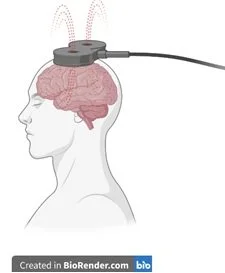
Figure 1: Transcranial magnetic stimulation. This technique involves applying pulses of magnetic stimulation to specific areas of the brain from a probe placed on or above the scalp.
Why is the study important?
Dysphagia, or swallowing difficulties, is a common consequence of stroke due to brain damage in the area that controls swallowing and can have a significant impact on the quality of life and recovery after a stroke. People that have suffered a stroke who then develop dysphagia have a higher rate of complications, such as weight loss, or lung infections from accidently inhaling food, also known as aspiration. This results in a higher risk of hospitalisation and death, and may require feeding tubes to ensure patients receive adequate nutrition. However, these feeding tube carry risks of their own, such as infection.
Current techniques to help manage dysphagia primarily involve physical therapy and are usually effective at improving swallowing. However, they are often hindered by the other complications of stroke, such as tiredness and low mood which may make engaging in physical therapy more difficult.
What did the authors do and how did they do it?
Recent research has shown that the healthy side of the brain that has not been affected by stroke can create new connections in an attempt to restore swallowing. The authors targeted this compensation mechanism of the brain by applying magnetic stimulation to the healthy side of the brain to activate it and encourage it to create these new connections more quickly.
They recruited 38 individuals of varying age, sex, and ethnicity, who had recently suffered a stroke and developed significant dysphagia. They applied magnetic stimulation, alongside swallowing exercises, in two 20 minute sessions a day for 5 consecutive days. Their aim was to measure any improvements in the risk of accidentally inhaling food (aspiration) and measuring food intake. An improvement in either might represent an overall improvement in swallowing. The study was double-blinded , which means that both the researchers and participants were not aware who was receiving magnetic stimulation and who was not. This ensures that the results are not affected by bias and is the gold-standard of clinical trials.
What are the results?
The authors found that people who underwent transcranial magnetic stimulation had similar scores on the risk of aspiration to those that did not. This suggests that the transcranial magnetic stimulation alone did not directly reduce the risk of inhaling food. However, these scoring systems have been criticised as they are subjective measures and research has shown that some clinicians would give different scores to the same patient.
Nevertheless, the aim of any treatment for dysphagia is to improve overall food intake. The authors found that after 1 month, overall food intake was significantly higher in those that received transcranial magnetic stimulation compared to those who did not. This suggests an improvement in overall swallowing. Importantly, no participant withdrew from the study due to discomfort or pain and no participant suffered from a direct complication of the transcranial magnetic stimulation. This suggests that this method is painless, well tolerated, and easy to engage with, particularly since all the patients recruited were within the first few days of their stroke.
What do the finding mean going forward for people with the disease?
Transcranial magnetic stimulation has been deemed to be safe and effective by the NHS for other medical problems. The findings of this study are promising and may mean that this technique, alongside physical therapy, is integrated into stroke rehabilitation programmes to help to restore a safe swallow for people with dysphagia. This can reduce the risk of complications and may significantly improve the quality of life after a stroke.
This study can be found at: https://doi.org/10.1038%2Fs41598-022-14390-9
Paper title: Fostering eating after stroke (FEASt) trial for improving post-stroke dysphagia with non-invasive brain stimulation
Author list: Kumar S, Marchina S, Langmore S, Massaro J, Palmisano J, Wang N, Searls DE, Lioutas V, Pisegna J, Wagner C, Shinde A, and Schlaug G.
Publication details including date of publication: Published in Scientific Reports on 10th June 2022
Citation: Kumar S, Marchina S, Langmore S, Massaro J, Palmisano J, Wang N, Searls DE, Lioutas V, Pisegna J, Wagner C, Shinde A, Schlaug G. Fostering eating after stroke (FEASt) trial for improving post-stroke dysphagia with non-invasive brain stimulation. Sci Rep. 2022;12(1):9607.